
次のステップ
最終更新日:2026-11-07 | ページの編集
所要時間: 90分
概要
質問
-
SummarizedExperimentとは何ですか? - Bioconductorとは何ですか?
目的
- Bioconductorプロジェクトについて紹介します。
- データコンテナの概念を紹介します。
- オミクス解析で広く用いられる
SummarizedExperimentの概要を説明してください。
次のステップ
バイオインフォマティクスにおけるデータは、複雑な場合が多くあります。これに対処するため、開発者は扱う必要のあるデータの特性に合わせた専用のデータコンテナ(クラスと呼ばれます)を定義します。
この側面は、パッケージ間で共通のコアデータ基盤を採用しているBioconductor1プロジェクトの中核をなすものです。これは間違いなくBioconductorの成功に寄与しました。Bioconductorのパッケージ開発者は、プロジェクト全体に一貫性、相互運用性、および安定性をもたらすため、既存の基盤を活用することが推奨されています。
このようなオミクスデータコンテナの例として、SummarizedExperimentクラスを紹介します。
SummarizedExperiment
下図は、SummarizedExperimentクラスの構成を示しています。

SummarizedExperimentクラスのオブジェクトには、以下が含まれます。
行列形式のオブジェクトとして格納された定量的なオミクスデータ(発現データ)を含む1つ(または複数)のアッセイです。行方向に特徴量(遺伝子、転写産物、タンパク質など)が、列方向にサンプルが定義されています。
サンプルの共変量を格納したサンプルメタデータスロットです。データフレームとして保存されています。このテーブルの行はサンプルを表します(行は発現データの列と完全に一致します)。
特徴量の共変量を格納した特徴量メタデータスロットです。データフレームとして保存されています。このデータフレームの行は、発現データの行と完全に一致します。
SummarizedExperimentの整合性により、データ操作時に異なるスロットの次元が常に一致することが保証されます(すなわち、発現データの列とサンプルメタデータの行、および発現データの行と特徴量メタデータの行が一致します)。例えば、アッセイから1つのサンプルを除外する場合、同一の操作によってサンプルメタデータからも自動的に削除されます。
メタデータスロットには、他の構造に影響を与えることなく、追加の共変量(列)を加えることができます。
SummarizedExperimentの作成
SummarizedExperimentを作成するため、個々の構成要素、すなわちカウント行列、サンプルおよび遺伝子のメタデータをCSVファイルから作成します。これらは通常、RNA-Seqデータ(生データの処理後)の提供形式となっています。
-
発現行列:カウント行列を読み込み、最初の列に行名/遺伝子名が含まれていることを指定して、
data.frameをmatrixに変換します。こちらのリンクからダウンロードいただけます。
R
count_matrix <- read.csv("data/count_matrix.csv",
                         row.names = 1) |>
    as.matrix()

count_matrix[1:5, ]
出力
        GSM2545336 GSM2545337 GSM2545338 GSM2545339 GSM2545340 GSM2545341
Asl           1170        361        400        586        626        988
Apod         36194      10347       9173      10620      13021      29594
Cyp2d22       4060       1616       1603       1901       2171       3349
Klk6           287        629        641        578        448        195
Fcrls           85        233        244        237        180         38
        GSM2545342 GSM2545343 GSM2545344 GSM2545345 GSM2545346 GSM2545347
Asl            836        535        586        597        938       1035
Apod         24959      13668      13230      15868      27769      34301
Cyp2d22       3122       2008       2254       2277       2985       3452
Klk6           186       1101        537        567        327        233
Fcrls           68        375        199        177         89         67
        GSM2545348 GSM2545349 GSM2545350 GSM2545351 GSM2545352 GSM2545353
Asl            494        481        666        937        803        541
Apod         11258      11812      15816      29242      20415      13682
Cyp2d22       1883       2014       2417       3678       2920       2216
Klk6           742        881        828        250        798        710
Fcrls          300        233        231         81        303        285
        GSM2545354 GSM2545362 GSM2545363 GSM2545380
Asl            473        748        576       1192
Apod         11088      15916      11166      38148
Cyp2d22       1821       2842       2011       4019
Klk6           894        501        598        259
Fcrls          248        179        184         68
R
dim(count_matrix)
出力
[1] 1474 22- サンプルの説明表は、こちらのリンクからご覧いただけます。
R
sample_metadata <- read.csv("data/sample_metadata.csv")
sample_metadata
出力
       sample     organism age    sex   infection  strain time     tissue mouse
1  GSM2545336 Mus musculus   8 Female  InfluenzaA C57BL/6    8 Cerebellum    14
2  GSM2545337 Mus musculus   8 Female NonInfected C57BL/6    0 Cerebellum     9
3  GSM2545338 Mus musculus   8 Female NonInfected C57BL/6    0 Cerebellum    10
4  GSM2545339 Mus musculus   8 Female  InfluenzaA C57BL/6    4 Cerebellum    15
5  GSM2545340 Mus musculus   8   Male  InfluenzaA C57BL/6    4 Cerebellum    18
6  GSM2545341 Mus musculus   8   Male  InfluenzaA C57BL/6    8 Cerebellum     6
7  GSM2545342 Mus musculus   8 Female  InfluenzaA C57BL/6    8 Cerebellum     5
8  GSM2545343 Mus musculus   8   Male NonInfected C57BL/6    0 Cerebellum    11
9  GSM2545344 Mus musculus   8 Female  InfluenzaA C57BL/6    4 Cerebellum    22
10 GSM2545345 Mus musculus   8   Male  InfluenzaA C57BL/6    4 Cerebellum    13
11 GSM2545346 Mus musculus   8   Male  InfluenzaA C57BL/6    8 Cerebellum    23
12 GSM2545347 Mus musculus   8   Male  InfluenzaA C57BL/6    8 Cerebellum    24
13 GSM2545348 Mus musculus   8 Female NonInfected C57BL/6    0 Cerebellum     8
14 GSM2545349 Mus musculus   8   Male NonInfected C57BL/6    0 Cerebellum     7
15 GSM2545350 Mus musculus   8   Male  InfluenzaA C57BL/6    4 Cerebellum     1
16 GSM2545351 Mus musculus   8 Female  InfluenzaA C57BL/6    8 Cerebellum    16
17 GSM2545352 Mus musculus   8 Female  InfluenzaA C57BL/6    4 Cerebellum    21
18 GSM2545353 Mus musculus   8 Female NonInfected C57BL/6    0 Cerebellum     4
19 GSM2545354 Mus musculus   8   Male NonInfected C57BL/6    0 Cerebellum     2
20 GSM2545362 Mus musculus   8 Female  InfluenzaA C57BL/6    4 Cerebellum    20
21 GSM2545363 Mus musculus   8   Male  InfluenzaA C57BL/6    4 Cerebellum    12
22 GSM2545380 Mus musculus   8 Female  InfluenzaA C57BL/6    8 Cerebellum    19
R
dim(sample_metadata)
出力
[1] 22 9- 遺伝子に関する表は、こちらのリンクからご覧いただけます。
R
gene_metadata <- read.csv("data/gene_metadata.csv")
gene_metadata[1:10, 1:4]
出力
      gene ENTREZID
1      Asl   109900
2     Apod    11815
3  Cyp2d22    56448
4     Klk6    19144
5    Fcrls    80891
6   Slc2a4    20528
7     Exd2    97827
8     Gjc2   118454
9     Plp1    18823
10    Gnb4    14696
                                                                         product
1                                 argininosuccinate lyase, transcript variant X1
2                                         apolipoprotein D, transcript variant 3
3   cytochrome P450, family 2, subfamily d, polypeptide 22, transcript variant 2
4                           kallikrein related-peptidase 6, transcript variant 2
5                  Fc receptor-like S, scavenger receptor, transcript variant X1
6            solute carrier family 2 (facilitated glucose transporter), member 4
7                                          exonuclease 3'-5' domain containing 2
8                            gap junction protein, gamma 2, transcript variant 1
9                           proteolipid protein (myelin) 1, transcript variant 1
10 guanine nucleotide binding protein (G protein), beta 4, transcript variant X2
      ensembl_gene_id
1  ENSMUSG00000025533
2  ENSMUSG00000022548
3  ENSMUSG00000061740
4  ENSMUSG00000050063
5  ENSMUSG00000015852
6  ENSMUSG00000018566
7  ENSMUSG00000032705
8  ENSMUSG00000043448
9  ENSMUSG00000031425
10 ENSMUSG00000027669
R
dim(gene_metadata)
出力
[1] 1474 9これらのテーブルからSummarizedExperimentを作成します。
assayとして使用されるカウント行列サンプルを記述した表は、サンプルメタデータスロットとして使用されます。
遺伝子を記述したテーブルは、features metadataスロットとして使用されます。
これを行うには、SummarizedExperiment
コンストラクタを用いて各パーツを組み合わせることができます。
R
## BiocManager::install("SummarizedExperiment")
library("SummarizedExperiment")
まず、カウント行列とサンプルアノテーションにおいてサンプルの順序が一致していること、およびカウント行列と遺伝子アノテーションにおいて遺伝子の順序が一致していることを確認します。
R
stopifnot(rownames(count_matrix) == gene_metadata$gene)
stopifnot(colnames(count_matrix) == sample_metadata$sample)
R
se <- SummarizedExperiment(assays = list(counts = count_matrix),
                           colData = sample_metadata,
                           rowData = gene_metadata)
se
出力
class: SummarizedExperiment
dim: 1474 22
metadata(0):
assays(1): counts
rownames(1474): Asl Apod ... Lmx1a Pbx1
rowData names(9): gene ENTREZID ... phenotype_description
  hsapiens_homolog_associated_gene_name
colnames(22): GSM2545336 GSM2545337 ... GSM2545363 GSM2545380
colData names(9): sample organism ... tissue mouse
データの保存
前回のエピソードで行ったようなスプレッドシートへのデータエクスポートには、第1章で述べた点(小数点区切り文字に関する,と.の不整合の可能性や、変数型の定義がないことなど)など、いくつかの制約があります。さらに、スプレッドシートへのデータエクスポートが有効なのは、データフレームや行列のような矩形データに限られます。
R特有の、いかなるオペレーティングシステムでも確実に動作するより汎用的なデータ保存方法は、saveRDS関数を使用することです。このようにオブジェクトを保存すると、ディスク上にバイナリ形式のデータ(ここではrdsというファイル拡張子を使用)が生成され、これをreadRDS関数を用いてRに読み込むことができます。
R
saveRDS(se, file = "data_output/se.rds")
rm(se)
se <- readRDS("data_output/se.rds")
head(se)
まとめとして、Rで保存し、再度Rで読み込むデータについては、saveRDSおよびreadRDSを用いて保存・読み込みを行う方法が推奨されます。表形式のデータをRを使用していない相手と共有する必要がある場合は、テキストベースのスプレッドシートにエクスポートすることも有効な選択肢となります。
このデータ構造を用いることで、assay関数で発現行列にアクセスできます。
R
head(assay(se))
出力
        GSM2545336 GSM2545337 GSM2545338 GSM2545339 GSM2545340 GSM2545341
Asl           1170        361        400        586        626        988
Apod         36194      10347       9173      10620      13021      29594
Cyp2d22       4060       1616       1603       1901       2171       3349
Klk6           287        629        641        578        448        195
Fcrls           85        233        244        237        180         38
Slc2a4         782        231        248        265        313        786
        GSM2545342 GSM2545343 GSM2545344 GSM2545345 GSM2545346 GSM2545347
Asl            836        535        586        597        938       1035
Apod         24959      13668      13230      15868      27769      34301
Cyp2d22       3122       2008       2254       2277       2985       3452
Klk6           186       1101        537        567        327        233
Fcrls           68        375        199        177         89         67
Slc2a4         528        249        266        357        654        693
        GSM2545348 GSM2545349 GSM2545350 GSM2545351 GSM2545352 GSM2545353
Asl            494        481        666        937        803        541
Apod         11258      11812      15816      29242      20415      13682
Cyp2d22       1883       2014       2417       3678       2920       2216
Klk6           742        881        828        250        798        710
Fcrls          300        233        231         81        303        285
Slc2a4         271        304        349        715        513        320
        GSM2545354 GSM2545362 GSM2545363 GSM2545380
Asl            473        748        576       1192
Apod         11088      15916      11166      38148
Cyp2d22       1821       2842       2011       4019
Klk6           894        501        598        259
Fcrls          248        179        184         68
Slc2a4         248        350        317        796
R
dim(assay(se))
出力
[1] 1474 22colData関数を使用して、サンプルのメタデータにアクセスできます。
R
colData(se)
出力
DataFrame with 22 rows and 9 columns
                sample     organism       age         sex   infection
           <character>  <character> <integer> <character> <character>
GSM2545336  GSM2545336 Mus musculus         8      Female  InfluenzaA
GSM2545337  GSM2545337 Mus musculus         8      Female NonInfected
GSM2545338  GSM2545338 Mus musculus         8      Female NonInfected
GSM2545339  GSM2545339 Mus musculus         8      Female  InfluenzaA
GSM2545340  GSM2545340 Mus musculus         8        Male  InfluenzaA
...                ...          ...       ...         ...         ...
GSM2545353  GSM2545353 Mus musculus         8      Female NonInfected
GSM2545354  GSM2545354 Mus musculus         8        Male NonInfected
GSM2545362  GSM2545362 Mus musculus         8      Female  InfluenzaA
GSM2545363  GSM2545363 Mus musculus         8        Male  InfluenzaA
GSM2545380  GSM2545380 Mus musculus         8      Female  InfluenzaA
                strain      time      tissue     mouse
           <character> <integer> <character> <integer>
GSM2545336     C57BL/6         8  Cerebellum        14
GSM2545337     C57BL/6         0  Cerebellum         9
GSM2545338     C57BL/6         0  Cerebellum        10
GSM2545339     C57BL/6         4  Cerebellum        15
GSM2545340     C57BL/6         4  Cerebellum        18
...                ...       ...         ...       ...
GSM2545353     C57BL/6         0  Cerebellum         4
GSM2545354     C57BL/6         0  Cerebellum         2
GSM2545362     C57BL/6         4  Cerebellum        20
GSM2545363     C57BL/6         4  Cerebellum        12
GSM2545380     C57BL/6         8  Cerebellum        19
R
dim(colData(se))
出力
[1] 22 9また、rowData関数を使用してフィーチャーのメタデータにアクセスすることもできます。
R
head(rowData(se))
出力
DataFrame with 6 rows and 9 columns
               gene  ENTREZID                product    ensembl_gene_id
        <character> <integer>            <character>        <character>
Asl             Asl    109900 argininosuccinate ly.. ENSMUSG00000025533
Apod           Apod     11815 apolipoprotein D, tr.. ENSMUSG00000022548
Cyp2d22     Cyp2d22     56448 cytochrome P450, fam.. ENSMUSG00000061740
Klk6           Klk6     19144 kallikrein related-p.. ENSMUSG00000050063
Fcrls         Fcrls     80891 Fc receptor-like S, .. ENSMUSG00000015852
Slc2a4       Slc2a4     20528 solute carrier famil.. ENSMUSG00000018566
        external_synonym chromosome_name   gene_biotype  phenotype_description
             <character>     <character>    <character>            <character>
Asl        2510006M18Rik               5 protein_coding abnormal circulating..
Apod                  NA              16 protein_coding abnormal lipid homeo..
Cyp2d22             2D22              15 protein_coding abnormal skin morpho..
Klk6                Bssp               7 protein_coding abnormal cytokine le..
Fcrls      2810439C17Rik               3 protein_coding decreased CD8-positi..
Slc2a4            Glut-4              11 protein_coding abnormal circulating..
        hsapiens_homolog_associated_gene_name
                                  <character>
Asl                                       ASL
Apod                                     APOD
Cyp2d22                                CYP2D6
Klk6                                     KLK6
Fcrls                                   FCRL2
Slc2a4                                 SLC2A4
R
dim(rowData(se))
出力
[1] 1474 9SummarizedExperimentのサブセット抽出
SummarizedExperimentは、データフレームと同様に、数値、文字、または論理値を用いてサブセットを抽出できます。
以下では、最初の3つのサンプルの最初の5つの特徴量のみを含むSummarizedExperimentクラスの新しいインスタンスを作成します。
R
se1 <- se[1:5, 1:3]
se1
出力
class: SummarizedExperiment
dim: 5 3
metadata(0):
assays(1): counts
rownames(5): Asl Apod Cyp2d22 Klk6 Fcrls
rowData names(9): gene ENTREZID ... phenotype_description
  hsapiens_homolog_associated_gene_name
colnames(3): GSM2545336 GSM2545337 GSM2545338
colData names(9): sample organism ... tissue mouse
R
colData(se1)
出力
DataFrame with 3 rows and 9 columns
                sample     organism       age         sex   infection
           <character>  <character> <integer> <character> <character>
GSM2545336  GSM2545336 Mus musculus         8      Female  InfluenzaA
GSM2545337  GSM2545337 Mus musculus         8      Female NonInfected
GSM2545338  GSM2545338 Mus musculus         8      Female NonInfected
                strain      time      tissue     mouse
           <character> <integer> <character> <integer>
GSM2545336     C57BL/6         8  Cerebellum        14
GSM2545337     C57BL/6         0  Cerebellum         9
GSM2545338     C57BL/6         0  Cerebellum        10
R
rowData(se1)
出力
DataFrame with 5 rows and 9 columns
               gene  ENTREZID                product    ensembl_gene_id
        <character> <integer>            <character>        <character>
Asl             Asl    109900 argininosuccinate ly.. ENSMUSG00000025533
Apod           Apod     11815 apolipoprotein D, tr.. ENSMUSG00000022548
Cyp2d22     Cyp2d22     56448 cytochrome P450, fam.. ENSMUSG00000061740
Klk6           Klk6     19144 kallikrein related-p.. ENSMUSG00000050063
Fcrls         Fcrls     80891 Fc receptor-like S, .. ENSMUSG00000015852
        external_synonym chromosome_name   gene_biotype  phenotype_description
             <character>     <character>    <character>            <character>
Asl        2510006M18Rik               5 protein_coding abnormal circulating..
Apod                  NA              16 protein_coding abnormal lipid homeo..
Cyp2d22             2D22              15 protein_coding abnormal skin morpho..
Klk6                Bssp               7 protein_coding abnormal cytokine le..
Fcrls      2810439C17Rik               3 protein_coding decreased CD8-positi..
        hsapiens_homolog_associated_gene_name
                                  <character>
Asl                                       ASL
Apod                                     APOD
Cyp2d22                                CYP2D6
Klk6                                     KLK6
Fcrls FCRL2また、colData()関数を用いてサンプルメタデータから、rowData()関数を用いてフィーチャーメタデータから、それぞれ条件を指定してサブセットを抽出することもできます。例えば、ここではmiRNAと非感染サンプルのみを残します:
R
se1 <- se[rowData(se)$gene_biotype == "miRNA",
          colData(se)$infection == "NonInfected"]
se1
出力
class: SummarizedExperiment
dim: 7 7
metadata(0):
assays(1): counts
rownames(7): Mir1901 Mir378a ... Mir128-1 Mir7682
rowData names(9): gene ENTREZID ... phenotype_description
  hsapiens_homolog_associated_gene_name
colnames(7): GSM2545337 GSM2545338 ... GSM2545353 GSM2545354
colData names(9): sample organism ... tissue mouse
R
assay(se1)
出力
         GSM2545337 GSM2545338 GSM2545343 GSM2545348 GSM2545349 GSM2545353
Mir1901          45         44         74         55         68         33
Mir378a          11          7          9          4         12          4
Mir133b           4          6          5          4          6          7
Mir30c-2         10          6         16         12          8         17
Mir149            1          2          0          0          0          0
Mir128-1          4          1          2          2          1          2
Mir7682           2          0          4          1          3          5
         GSM2545354
Mir1901          60
Mir378a           8
Mir133b           3
Mir30c-2         15
Mir149            2
Mir128-1          1
Mir7682           5
R
colData(se1)
出力
DataFrame with 7 rows and 9 columns
                sample     organism       age         sex   infection
           <character>  <character> <integer> <character> <character>
GSM2545337  GSM2545337 Mus musculus         8      Female NonInfected
GSM2545338  GSM2545338 Mus musculus         8      Female NonInfected
GSM2545343  GSM2545343 Mus musculus         8        Male NonInfected
GSM2545348  GSM2545348 Mus musculus         8      Female NonInfected
GSM2545349  GSM2545349 Mus musculus         8        Male NonInfected
GSM2545353  GSM2545353 Mus musculus         8      Female NonInfected
GSM2545354  GSM2545354 Mus musculus         8        Male NonInfected
                strain      time      tissue     mouse
           <character> <integer> <character> <integer>
GSM2545337     C57BL/6         0  Cerebellum         9
GSM2545338     C57BL/6         0  Cerebellum        10
GSM2545343     C57BL/6         0  Cerebellum        11
GSM2545348     C57BL/6         0  Cerebellum         8
GSM2545349     C57BL/6         0  Cerebellum         7
GSM2545353     C57BL/6         0  Cerebellum         4
GSM2545354     C57BL/6         0  Cerebellum         2
R
rowData(se1)
出力
DataFrame with 7 rows and 9 columns
                gene  ENTREZID        product    ensembl_gene_id
         <character> <integer>    <character>        <character>
Mir1901      Mir1901 100316686  microRNA 1901 ENSMUSG00000084565
Mir378a      Mir378a    723889  microRNA 378a ENSMUSG00000105200
Mir133b      Mir133b    723817  microRNA 133b ENSMUSG00000065480
Mir30c-2    Mir30c-2    723964 microRNA 30c-2 ENSMUSG00000065567
Mir149        Mir149    387167   microRNA 149 ENSMUSG00000065470
Mir128-1    Mir128-1    387147 microRNA 128-1 ENSMUSG00000065520
Mir7682      Mir7682 102466847  microRNA 7682 ENSMUSG00000106406
         external_synonym chromosome_name gene_biotype  phenotype_description
              <character>     <character>  <character>            <character>
Mir1901          Mirn1901              18        miRNA                     NA
Mir378a           Mirn378              18        miRNA abnormal mitochondri..
Mir133b          mir 133b               1        miRNA no abnormal phenotyp..
Mir30c-2        mir 30c-2               1        miRNA                     NA
Mir149            Mirn149               1        miRNA increased circulatin..
Mir128-1          Mirn128               1        miRNA no abnormal phenotyp..
Mir7682      mmu-mir-7682               1        miRNA                     NA
         hsapiens_homolog_associated_gene_name
                                   <character>
Mir1901                                     NA
Mir378a                                MIR378A
Mir133b                                MIR133B
Mir30c-2                               MIR30C2
Mir149                                      NA
Mir128-1                              MIR128-1
Mir7682 NA課題
時刻0および時刻8におけるサンプルの先頭3つの遺伝子の発現量を抽出してください。
R
assay(se)[1:3, colData(se)$time != 4]
出力
        GSM2545336 GSM2545337 GSM2545338 GSM2545341 GSM2545342 GSM2545343
Asl           1170        361        400        988        836        535
Apod         36194      10347       9173      29594      24959      13668
Cyp2d22       4060       1616       1603       3349       3122       2008
        GSM2545346 GSM2545347 GSM2545348 GSM2545349 GSM2545351 GSM2545353
Asl            938       1035        494        481        937        541
Apod         27769      34301      11258      11812      29242      13682
Cyp2d22       2985       3452       1883       2014       3678       2216
        GSM2545354 GSM2545380
Asl            473       1192
Apod         11088      38148
Cyp2d22       1821       4019
R
# Equivalent to
assay(se)[1:3, colData(se)$time == 0 | colData(se)$time == 8]
出力
        GSM2545336 GSM2545337 GSM2545338 GSM2545341 GSM2545342 GSM2545343
Asl           1170        361        400        988        836        535
Apod         36194      10347       9173      29594      24959      13668
Cyp2d22       4060       1616       1603       3349       3122       2008
        GSM2545346 GSM2545347 GSM2545348 GSM2545349 GSM2545351 GSM2545353
Asl            938       1035        494        481        937        541
Apod         27769      34301      11258      11812      29242      13682
Cyp2d22       2985       3452       1883       2014       3678       2216
        GSM2545354 GSM2545380
Asl            473       1192
Apod         11088      38148
Cyp2d22 1821 4019課題
ロング形式のrnaテーブルを使用して、同じ値が得られることを確認してください。
R
rna |>
    filter(gene %in% c("Asl", "Apod", "Cyd2d22")) |>
    filter(time != 4) |>
    select(expression)
出力
# A tibble: 28 × 1
   expression
        <dbl>
 1       1170
 2      36194
 3        361
 4      10347
 5        400
 6       9173
 7        988
 8      29594
 9        836
10      24959
# ℹ 18 more rowsロングテーブルとSummarizedExperimentは同じ情報を含んでいますが、単に構造が異なるだけです。それぞれの手法に利点があります。前者はtidyverseパッケージに適しており、後者は多くのバイオインフォマティクスや統計処理の手順において好まれる構造です。例えば、DESeq2パッケージを用いた典型的なRNA-Seq解析などが挙げられます。
メタデータへの変数の追加
メタデータに情報を追加することもできます。例えば、サンプルを採取した場所を追加したいとしましょう…
R
colData(se)$center <- rep("University of Illinois", nrow(colData(se)))
colData(se)
出力
DataFrame with 22 rows and 10 columns
                sample     organism       age         sex   infection
           <character>  <character> <integer> <character> <character>
GSM2545336  GSM2545336 Mus musculus         8      Female  InfluenzaA
GSM2545337  GSM2545337 Mus musculus         8      Female NonInfected
GSM2545338  GSM2545338 Mus musculus         8      Female NonInfected
GSM2545339  GSM2545339 Mus musculus         8      Female  InfluenzaA
GSM2545340  GSM2545340 Mus musculus         8        Male  InfluenzaA
...                ...          ...       ...         ...         ...
GSM2545353  GSM2545353 Mus musculus         8      Female NonInfected
GSM2545354  GSM2545354 Mus musculus         8        Male NonInfected
GSM2545362  GSM2545362 Mus musculus         8      Female  InfluenzaA
GSM2545363  GSM2545363 Mus musculus         8        Male  InfluenzaA
GSM2545380  GSM2545380 Mus musculus         8      Female  InfluenzaA
                strain      time      tissue     mouse                 center
           <character> <integer> <character> <integer>            <character>
GSM2545336     C57BL/6         8  Cerebellum        14 University of Illinois
GSM2545337     C57BL/6         0  Cerebellum         9 University of Illinois
GSM2545338     C57BL/6         0  Cerebellum        10 University of Illinois
GSM2545339     C57BL/6         4  Cerebellum        15 University of Illinois
GSM2545340     C57BL/6         4  Cerebellum        18 University of Illinois
...                ...       ...         ...       ...                    ...
GSM2545353     C57BL/6         0  Cerebellum         4 University of Illinois
GSM2545354     C57BL/6         0  Cerebellum         2 University of Illinois
GSM2545362     C57BL/6         4  Cerebellum        20 University of Illinois
GSM2545363     C57BL/6         4  Cerebellum        12 University of Illinois
GSM2545380     C57BL/6         8  Cerebellum        19 University of Illinois
これは、メタデータスロットが他の構造に影響を与えることなく、無制限に拡張できることを示しています!
tidySummarizedExperiment
tidyverseのコマンドを使ってSummarizedExperimentオブジェクトを操作できるのか、疑問に思われるかもしれません。答えは「はい」です。tidySummarizedExperimentパッケージを使えば可能です。
SummarizedExperimentオブジェクトがどのような見た目だったか、思い出してください。
R
se
出力
class: SummarizedExperiment
dim: 1474 22
metadata(0):
assays(1): counts
rownames(1474): Asl Apod ... Lmx1a Pbx1
rowData names(9): gene ENTREZID ... phenotype_description
  hsapiens_homolog_associated_gene_name
colnames(22): GSM2545336 GSM2545337 ... GSM2545363 GSM2545380
colData names(10): sample organism ... mouse centertidySummarizedExperimentを読み込み、改めてseオブジェクトを確認してください。
R
## BiocManager::install("tidySummarizedExperiment")
library("tidySummarizedExperiment")

se
出力
class: SummarizedExperiment
dim: 1474 22
metadata(0):
assays(1): counts
rownames(1474): Asl Apod ... Lmx1a Pbx1
rowData names(9): gene ENTREZID ... phenotype_description
  hsapiens_homolog_associated_gene_name
colnames(22): GSM2545336 GSM2545337 ... GSM2545363 GSM2545380
colData names(10): sample organism ... mouse center依然としてSummarizedExperimentオブジェクトであるため、効率的な構造が維持されていますが、現在はtibbleとして扱うことができます。出力の1行目にそう記載されている点に注目してください。これはSummarizedExperiment-tibbleという抽象化です。また、出力の2行目で転写産物数とサンプル数を確認できます。
これで、tidyverseのコマンドを使ってSummarizedExperimentオブジェクトを操作できるようになりました。
filter
を使用して、条件に基づいて行をフィルタリングできます。例えば、あるサンプルのすべての行を表示する場合などです。
R
se |> filter(sample == "GSM2545336")
出力
class: SummarizedExperiment
dim: 1474 1
metadata(1): latest_filter_scope_report
assays(1): counts
rownames(1474): Asl Apod ... Lmx1a Pbx1
rowData names(9): gene ENTREZID ... phenotype_description
  hsapiens_homolog_associated_gene_name
colnames(1): GSM2545336
colData names(10): sample organism ... mouse center
R
se |> filter(sex == "Female")
出力
class: SummarizedExperiment
dim: 1474 12
metadata(1): latest_filter_scope_report
assays(1): counts
rownames(1474): Asl Apod ... Lmx1a Pbx1
rowData names(9): gene ENTREZID ... phenotype_description
  hsapiens_homolog_associated_gene_name
colnames(12): GSM2545336 GSM2545337 ... GSM2545362 GSM2545380
colData names(10): sample organism ... mouse center
select を使用して、表示したい列を指定できます。
R
se |> select(sample, sex)
警告
Warning: `when()` was deprecated in purrr 1.0.0.
ℹ Please use `if` instead.
ℹ The deprecated feature was likely used in the tidySummarizedExperiment
  package.
  Please report the issue at
  <https://github.com/stemangiola/tidySummarizedExperiment/issues>.
This warning is displayed once per session.
Call `lifecycle::last_lifecycle_warnings()` to see where this warning was
generated.
出力
tidySummarizedExperiment says: Key columns are missing. A data frame is returned for independent data analysis.出力
# A tibble: 32,428 × 2
   sample     sex
   <chr>      <chr>
 1 GSM2545336 Female
 2 GSM2545336 Female
 3 GSM2545336 Female
 4 GSM2545336 Female
 5 GSM2545336 Female
 6 GSM2545336 Female
 7 GSM2545336 Female
 8 GSM2545336 Female
 9 GSM2545336 Female
10 GSM2545336 Female
# ℹ 32,418 more rows
mutate を使用してメタデータ情報を追加できます。
R
se |> mutate(center = "Heidelberg University")
出力
class: SummarizedExperiment
dim: 1474 22
metadata(1): latest_mutate_scope_report
assays(1): counts
rownames(1474): Asl Apod ... Lmx1a Pbx1
rowData names(9): gene ENTREZID ... phenotype_description
  hsapiens_homolog_associated_gene_name
colnames(22): GSM2545336 GSM2545337 ... GSM2545363 GSM2545380
colData names(10): sample organism ... mouse center
また、tidyverseのパイプ |>
を使ってコマンドを組み合わせることもできます。例えば、group_by
と summarise
を組み合わせることで、各サンプルの合計カウントを取得できます。
R
se |>
    group_by(.sample) |>
    summarise(total_counts=sum(counts))
出力
tidySummarizedExperiment says: A data frame is returned for independent data analysis.出力
# A tibble: 22 × 2
   .sample    total_counts
   <chr>             <int>
 1 GSM2545336      3039671
 2 GSM2545337      2602360
 3 GSM2545338      2458618
 4 GSM2545339      2500082
 5 GSM2545340      2479024
 6 GSM2545341      2413723
 7 GSM2545342      2349728
 8 GSM2545343      3105652
 9 GSM2545344      2524137
10 GSM2545345      2506038
# ℹ 12 more rows
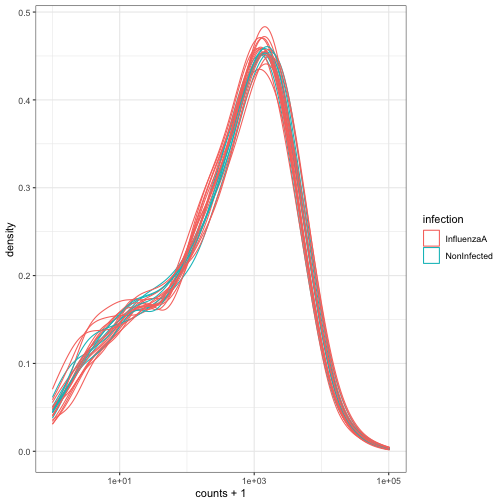
整然データのSummarizedExperimentオブジェクトは、プロット用に通常のtibbleとして扱うことができます。
ここでは、サンプルごとのカウント数の分布をプロットします。
R
se |>
    ggplot(aes(counts + 1, group=.sample, color=infection)) +
    geom_density() +
    scale_x_log10() +
    theme_bw()
tidySummarizedExperimentの詳細については、パッケージのウェブサイトをご覧ください。
要点
SummarizedExperimentは、オミクスデータを保存・扱うための効率的な手法です。これらは多くのBioconductorパッケージで使用されています。
次に予定されているRNAシーケンシング解析のトレーニングでは、BioconductorのDESeq2パッケージを使用して、発現変動解析を行う方法を学びます。DESeq2パッケージを用いた解析全体は、SummarizedExperimentで行われます。
- Bioconductorは、ハイスループット生物学データの解析を支援するためのサポートやパッケージを提供するプロジェクトです。
-
SummarizedExperimentは、ハイスループットなオミクスデータを保存・管理する際に有用なオブジェクトの一種です。
Bioconductorは、R言語の2人の創始者の一人であるロバート・ジェントルマンによって立ち上げられました。Bioconductorは、オミクスデータ解析に特化したツールを提供しています。Bioconductorは統計プログラミング言語Rを採用しており、オープンソースかつオープンな開発体制となっています。↩︎